
Ireland's batting cloud
Once a strength of this team, the batting line-up now looks unsure of their best scoring options

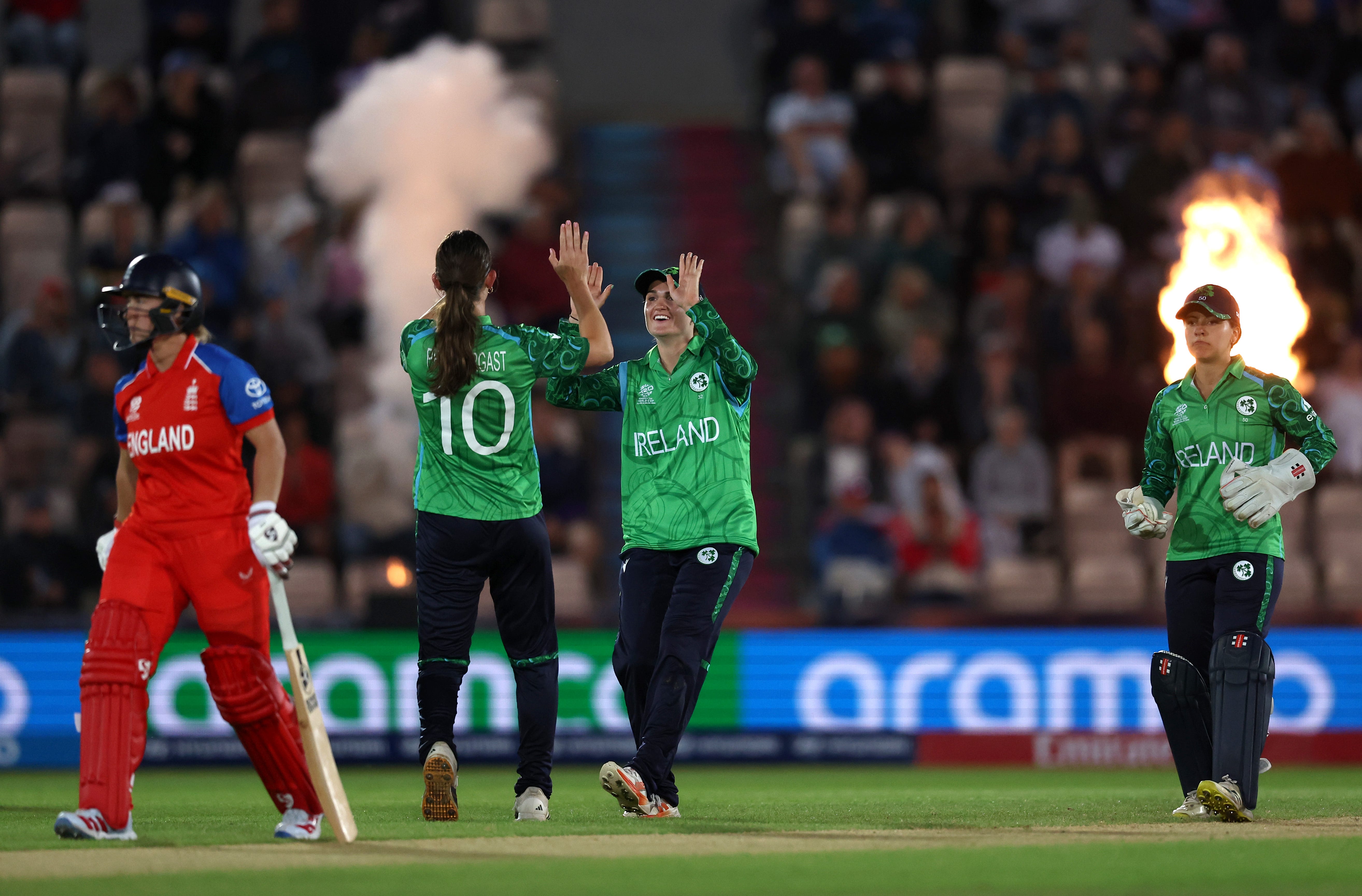
Ireland lose to England in their second T20 World Cup match. Scorecard here.
It’s amazing how drastically narratives can swing based on the direction of a cricket ball.
On Tuesday night in Southampton, Ireland captain Gaby Lewis walked across the stumps on her first ball faced. With Lauren Bell providing a bit of extra pace and fine leg inside the circle, Lewis chose aggression.
She made good contact. Adjusting to Bell firing it into her pad, it ended up being a sweep rather than a ramp. The ball flew off the middle of the bat but straight to Heather Knight at short fine. Well, not quite. It was a good catch, the former England captain moving well to her right.
A yard either side and Lewis is Ireland’s brave aggressor leading from the front. After criticism of a lack of intent in the powerplay against Scotland, she responds with a calculated option that sets the tone. Instead, Lewis opened herself up for criticism. Why not stick to her favoured strong shots down the ground?
That wicket was not the game’s deciding factor. Amy Hunter missing a sweep and Orla Prendergast chopping on were equally as decisive. But the captain making such a concerted effort to get on top betrays not quite desperation, but a clear need to outwardly show intent. On another day, it looks a genius move. On this occasion, it adds into the wider sense that Ireland’s batting, for so long this team’s strength, lacks the clarity required to succeed.
It’s not just a case of Lewis playing a shot that, while well executed, wouldn’t be considered a traditional strength. She was at the crease because Hunter fell into Linsey Smith’s trap. Bring up mid-wicket to tempt a sweep, bowl fast at the off stump and hope she misses. Snare set, the metal clasp snapped on Hunter’s hopes.
When she heard the ball rattle timber, Hunter threw up her hand in exasperation. It was a rare show of emotion from an even-keeled player. Was she frustrated at missing the ball, the choice of shot or falling too easily into the trap? Likely all of the above.
Or, was it frustration building at what was happening down the other end? Alana Dalzell avoided a fifth duck in seven innings opening the batting, but chewing up 18 balls for 14 runs inside the powerplay was hardly a better alternative. If there is less pressure on Hunter to pick up the slack, does she readily take Smith’s bait?
The Dalzell experiment as a whole screams being clever for clever’s sake. Yes, she opened in the Super Series, but asking her to step up against international new ball bowlers just five games out from a World Cup always seemed a big ask. Is she good enough for that role? Not yet, on the basis of 28 runs across seven games opening.
It’s not the player’s fault. The decision looks in hindsight to be a hospital pass given the lack of cricket played by Ireland. It will take strong leadership now to pivot mid-tournament while giving bad news to Dalzell.
The clear solution is to go back to Hunter and Lewis atop the order. Moving Prendergast down works if there is a strong alternative for the top three. Right now, there isn’t. Don’t overcomplicate things. Have the three best batters face as many balls as possible, taking reliable scoring options with the field up. Don’t be clever for the sake of being clever.
Across the board, dot balls were an issue for Ireland. They faced 49 deliveries without scoring on Tuesday, the equivalent of 8.1 overs. That’s 40% of a T20 innings where no runs are scored. With that sort of sluggishness, you haven’t a hope.
Whatever about lacking clarity on best boundary options, that builds a perception of a team unsure of how to simply get down the other end. Prendergast spoke on Saturday of Ireland being unable to utilise ones and twos to play their way out of trouble. Rinse and repeat against a stronger England side.
It’s an easy question to ask, bordering on lazy perhaps. But it’s still warranted. Ever since Ed Joyce opted against renewing his contract, Ireland have not had a specialist batting coach. New(ish) head coach Lloyd Tennant comes from a bowling background.
Has this impacted on the calculated aggression now missing from the powerplay? What about batters being unable to get off strike when pressure builds? The fact that Dominic Ostler was brought in as a batting consultant at the end of April suggests that someone figured there was a gap to be filled. A bit late perhaps considering it came just over six weeks from a World Cup.
When all put together, the evidence suggests this is a group lacking clarity. While the fielding display was an improvement, there were still strange decisions. If Alice Tector is a live bowling option in this World Cup, why was she not given the ball in the five games leading up to the tournament? Due to injury, she hasn’t bowled an international delivery since 2024. Off you go and bowl to Knight and Nat Sciver-Brunt.
On commentary, Isobel Joyce was critical of Ireland’s boundary riders being too deep. England found it too easy to run twos. Ditto Scotland, where depth meant fielders too often were uncomfortable charging in to take catches, instead letting the ball bounce six feet in front of them. Why was this lesson not learned from the weekend’s defeat?
When playing against stronger teams, plans can quickly go out the window. You have to be adaptable to find something that works. When it doesn’t work, desperation can come across as muddled thinking.
Prendergast looks in good touch with both bat and ball. Her dismissal was a tad unfortunate, the ball stopping in the pitch. All it takes is for her form to lead to a strong knock, Lewis to find a gap instead of a fielder and suddenly Ireland could have 150 against an imploding New Zealand team on Friday night.
The volatility of short form cricket ensures that if things go well for Ireland, they might not have to pivot from plan A. It’s perfectly conceivable that things go their way and they win the next three games. That would certainly change the narrative of this tournament.
Regardless, based on the evidence of the opening two games, Ireland have performed like a side unsure of what that plan A actually is. When that doesn’t work, plan B is unlikely to bring success either. Especially against more battle hardened teams.
Ireland don’t play enough international cricket, so this leaves limited opportunity to try out different theories
The Dazell experiment is one such example, this should have been done for the last 2 years not the last 3 weeks
Hunter Lewis and Pendergast have a valid claim to be as strong as any other top 3 outside of the top 4 teams
Only 120 balls so they need as many as possible
If only one of them comes off, it will still give a platform for Stokell and Paul to build on and Little to show her power to deliver a strong finish
What I fail to understand is why the change was made in the first place, in the qualifiers for this tournament, in the Netherlands and Nepal, I don’t recall there being a problem with having Lewis and Hunter open
The next 3 games are all effectively knock-out matches, by winning all 3 Ireland will have a chance of qualifying for the semifinals on the quirks of NRR
I fear that the experiment will continue and this outside chance of headline grabbing success will be lost