
Inside Ireland's spin resurgence
How George Dockrell's tweaked action allowed him to be Ireland's best bowler against Sri Lanka

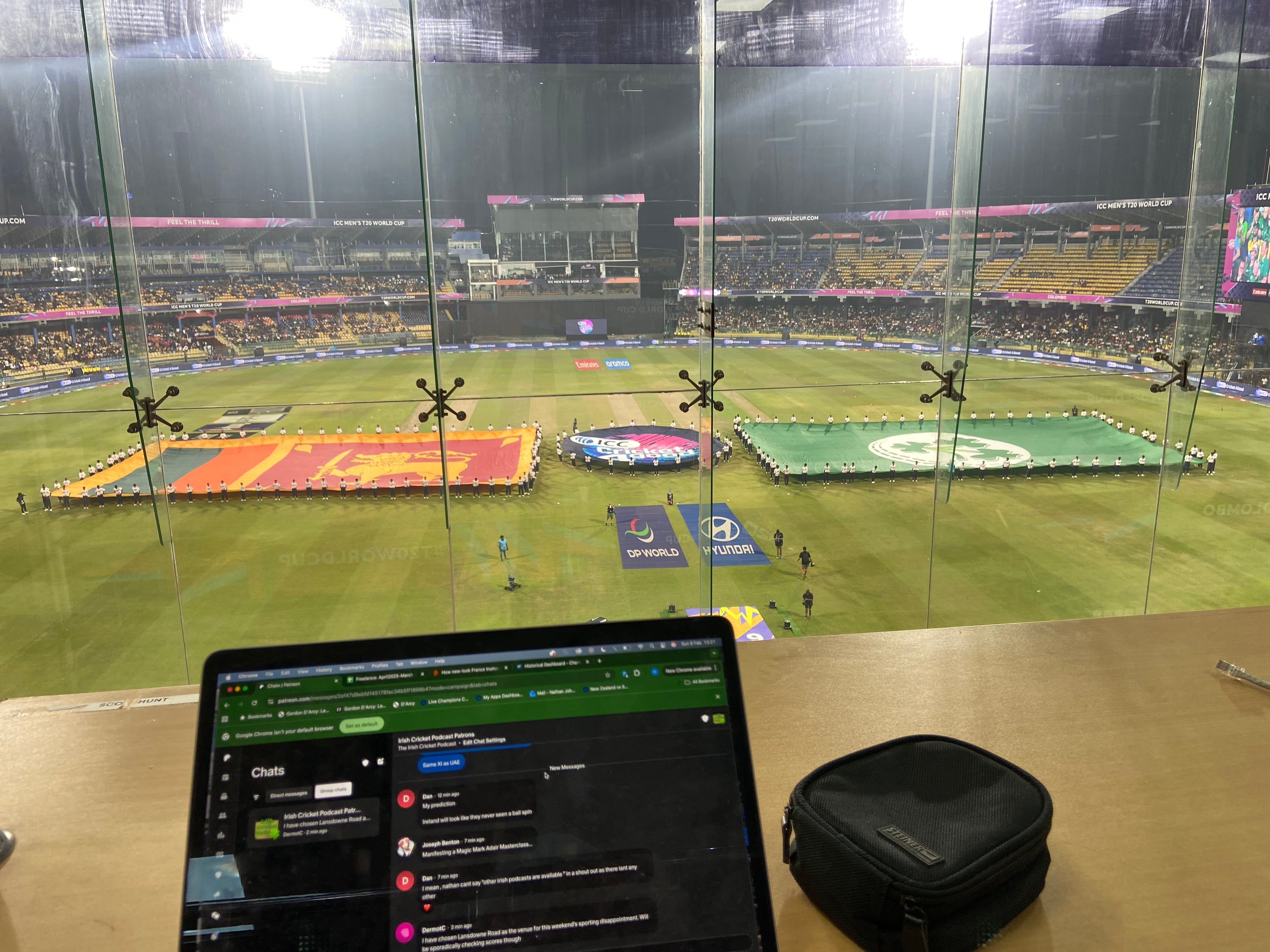
Many parts of a first cricketing visit to Asia matched expectations.
The tuk-tuk ride to the ground felt suitably perilous until you eventually got used to it. The noise and colour of street vendors created a stunning atmosphere - really should have bought a cheap Sri Lankan shirt while I had the chance.
Even the chaotic mission to secure a stray press pass lived up to the sub-continent’s famed lackadaisical approach to admin.
What defied pre-conceived notions, though, was the nature of the spin battle. One team struggled on a gripping surface. Their run rate was consistently below seven, at one point flirting with the six-an-over mark. They lost four of their six wickets to spin and, 16 overs in, looked to have been so dominated by the slow stuff that the game was up.
For all the success of Matthew Humphreys, Gareth Delany and George Dockrell in recent times, you’d have found few people who predicted that the above state of affairs would apply to Sri Lanka facing Irish spinners. Sri Lanka’s mystery spinners blowing Ireland away? I can see that. Ireland’s lack of mystery stalling a sub-continent team? That was more difficult to envisage.
A key question surrounding this Irish team has been answered. Sure, Messrs Humphreys, Delany and Dockrell performed against Italy and the UAE on helpful surfaces. Could they do it against a top tier nation under the lights in a World Cup?
By and large, the answer was an emphatic yes.
Humphreys bowled a superb opening over with the new ball. Spearing the ball quickly in towards the top of the stumps, no width was offered. You’d rather miss short than full, given the lack of protection down the ground. His two misses in that over were pulled to deep men square of the wicket. Five runs conceded; job done.
That, to be fair, was not unpredictable. Humphreys has been a stellar new ball option for Ireland for a while now. Teams’ analysis either is not picking up on a still new-ish trend (Ireland’s genius tactic of not playing enough cricket to supply footage) or the execution is so good that they don’t see it coming.
What happened later, Humphreys’ final over going for 21, can be caveated by the three drops off his bowling in that one over. One of which was spilled for six. The scorecard ain’t pretty, but facts tell a different tale.
Delany continues to be effective. He bowled very full at times with protection on the sweep to Kusal Mendis. He was a coat of varnish from seeing an umpire’s call LBW decision upheld in his favour. When he dragged his length back, a ripping googly, forcing left-hander Danish Wellalage to hit against the spin, bought him his lone wicket.
The story of the day, though, is undoubtedly Dockrell. Prior to the first T20 against Italy - six games ago - he had not bowled in his previous 13 T20 internationals. Since then, in five spells he has taken 6-70 at an average of 11.7. It’s a stunning return to form.
“I mentioned to the captain before the first game against Italy, even though he’s not bowled, he’s trained well,” said Chris Brown, Ireland’s spin coach. “Our spinners have been pretty consistent over a long period of time for us now. Particularly this tour, before this game. They’ve taken 22 wickets at under 5.5 economy, which is good.”
That last word came with the help of Brown’s notebook during the interview. A wandering eye across the table picked up what looked to be a scoring system during each over bowled by his spin charges. Information is constantly being gleaned.
“As a spinner, if you can be seven or under economy, that’s World Class. Anything around that is very good.” This calendar year, in this mini-run of excellence, Dockrell’s economy is 4.1.
“When he’s [Dockrell] bowling to me in the bowl through, I’ve noticed that - it’s taken a while - but his shape, posture, everything…sometimes you can tell with how the ball is going out and how it’s hitting the mitt,” continues Brown. “I said to Stirlo, if you get an opportunity…have him up your sleeve because he’s bowling well.”
Mention of the word posture is intriguing. Dockrell lost the faith of the coaching staff as a regular T20 option. Technical work has been done to earn it back, with a lot of help from Brown.
“Getting him really upright, making sure everything is going towards the target,” was the key according to the spin coach. “I’ve got a beer mat that I use as a target. I put it down on that five metre length and occasionally, because of his posture, he’ll come down the wrong side of the ball. I just said, ‘Bowl 24 balls today mate, and every single one of the 24 balls has to be this side of the mat. If you hit that mat on that side, we start again. Fucking make sure you bowl 24 balls there!’
“It is a bit of tough love, otherwise you’re doing it again. I also said I’d give him a prize if he did it at the end - I’m not going to say what that was - but he did it!
“[The plan is to have] good posture, good alignment, spin it as hard as you can, but try and be this side of the beer mat. Obviously, if there’s a left hander you can change it. He can’t bowl too straight, because his natural thing is that. If he can adjust his line, top of off stump, dragging the batsman forward.”
That’s the technical bit. In terms of the tactical, Dockrell’s two wickets came from the two deliveries which by and large make up the majority of his offering during this six match magic run. Either quick and flat at the stumps (why did Rathnayake try and upper cut a ball off leg stump?) or slow and wide outside off, hiding the ball outside the batter’s arc (Pathum Nissanka picked out cover reaching for one).
“But the length is still the same length,” interjects Brown. “The batter is unsure whether to come forward or back and that’s how you pin guys on the crease. That’s how you hit the top of the stumps - that five metre length.”
A lot of players and coaches are reluctant to get into the technicalities of the sport once a microphone is placed in front of them. There is something about spinners, though, loving their craft too much to care about that. They want to talk ball. Speaking to this publication last year, Humphreys detailed the revamping of his action which, under the tutelage of Brown, has brought about his recent success.
The point on showing Dockrell tough love also illustrates a coach who has learned how to communicate. Brown may well have figured out what makes at least some of his players tick. A few pints on tour no doubt helps.
Brown filled a significant hole when he came into this job. His predecessor, Nathan Hauritz, was very popular amongst the spin bowling group. His knowledge was respected, if not adored. He was, after all, a first full-time senior spin bowling coach. Neglected specialists were crying out for help.
Stepping in after Hauritz unexpectedly left the role for personal reasons, Brown has clearly had an impact. The results of Humphreys and Dockrell speak for themselves. The latter must wonder how his career might had progressed had he had this type of coaching before moving away from a bowling specialism.
His power hitting is still important - it was missed on Sunday. The challenge of Travis Head and Australia could also render positive stories on Dockrell and Ireland’s spin improvement somewhat premature. Still, there is a body of work that is impressive, with youngsters such as Gav Hoey yet to see the full rewards.
The biggest challenge preventing more good development stories? “We need to play more cricket, play more formats,” says Brown. “We’ll get there.”
Seven drops Jeremy, seven?
When dropped catches go a long way to costing a team a match, accountability does need to be taken. There is a perception out there that, off all the sport’s disciplines, fielding is the easiest to master.
So, to see Ireland drop seven catches in total (two difficult ones), including three in one over, was jarring. The good work done by Dockrell and co was undone - even if Harry Tector said the batting group should take responsibility for nevertheless failing to chase the required runs.
As the head coach, if standards slip anywhere, but especially in the field, the buck stops with Heinrich Malan. He didn’t take questions from the press after the game. This, in all likelihood, is because, as the sole Irish journalist there, I requested to speak to Brown to pick his brains on all things spin. Still, Malan could have done the press conference instead of Tector. Having worked adjacent to him for a few years now, he tends to be happy to avoid media if he can.
Tector didn’t drop any catches on Sunday. But he was still asked if, upon reflection, being caught so short on this stage reflected badly on the team’s preparation. “I don’t think so, to be honest,” he said.
“I don’t think we left stones unturned in terms of our preparation, fielding. We were pretty well drilled. That’s the disappointing aspect. If we weren’t practicing hard, taking catches under lights… I think they were isolated incidents. I personally didn’t think I was underprepared to catch balls under lights.”
Tector can only speak for himself. To be fair to the three players who had bad drops on Sunday - Ross Adair, Curtis Campher and Dockrell - they are all normally excellent fielders.
In terms of coaching, though, plenty have pointed out that there is no specialist fielding expert on the staff. No one whose job title includes that area. ‘Hire John Mooney as a fielding coach’ was a familiar refrain in WhatsApp groups last night, given he has done the job with Afghanistan.
Ireland don’t see the lack of formal coach as an impediment. “It’s not through a lack of preparation,” says Brown. “We was here yesterday, I must have spent an hour hitting balls, flats, highs, the lots. Under lights. They didn’t drop many.
“It is pressure but I’m not going to dwell on that. I don’t want to make it a big thing because it doesn’t happen very often. It shouldn’t happen at all at this level but everyone’s human. No one means to drop them.
“They’ve been really good in the field in Bangladesh, the last time we played T20s against the UAE and Italy. Outfield catching has been top drawer, faultless. There have been some real good catches in the deep. Unfortunately today… one goes down early off Barry McCarthy, another one, another one. It’s something you can’t put your finger on it. As a coach, you don’t dwell on it, it’s just a really bad day in the field. That should happen only one in 50.”
Let’s assess the full body of work with respect to fielding at the end of the World Cup. Nerves and the lights had an impact no doubt.