
A dark T20 day for Ireland
Ireland showed an inability to think their way out of a hole, putting in one of their worst displays in recent memory

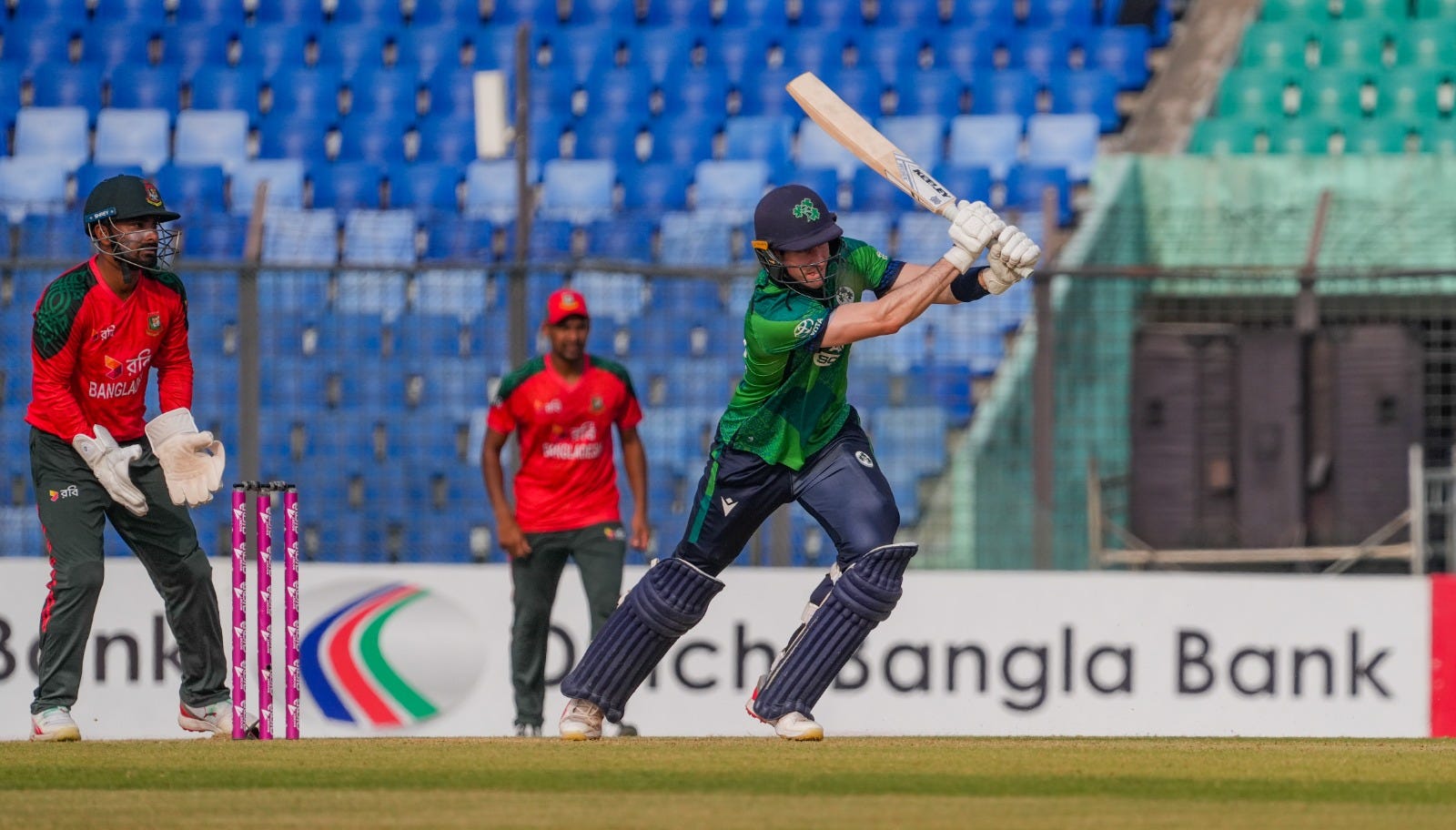
Bangladesh (119-2, 13.4 overs) beat Ireland (117 all out, 19.5 overs) by eight wickets.
Bangladesh win the series 2-1
Where to begin with that?
Paul Stirling and Heinrich Malan referenced fatigue as a factor behind the 8-wicket drubbing which wrapped up Ireland’s tour of Bangladesh. Those involved in the Test series have been away for nigh on four weeks. It’s a long time on the road.
Context like that can’t be turfed out the window. Nor can consideration of a tired pitch which suits a side more accustomed to slower bowling, as Bangladesh are always going to be in comparison to Ireland.
Still, for all the explanation, this was a shocker. Probably Ireland’s worst T20 display since losing to Canada at the World Cup in June 2024. Even then, the New York pitch and Ireland’s treatment at the hands of the ICC provided better mitigation than what we saw on Tuesday in Chattogram.
Ireland faced 54 dot balls in their innings, the equivalent of nine maidens. They went a 41-ball span without hitting a boundary. From overs six-10, Ireland recorded 16 runs for the loss of three wickets. Six members of the top eight had a strike rate under 100. There’s tiredness and tricky conditions, and there’s just not having a plan to counteract a fairly predictable challenge.
Spin and seamers bowling cutters into the pitch.
If this was Ireland’s kryptonite in game two, it blew Superman out of the sky on Tuesday. The warning signs were there early doors, Tim Tector struggling to connect on back-to-back slower balls from Shoriful Islam. When one finally landed in his half of the pitch, he launched it into the Ireland dugout at long-on. It was the last slot ball Ireland would receive.
After another good start from the Irish openers, despite a few play and misses, Ireland reached 50 off five overs. That’s when Bangladesh started to recover, Tector playing around a slower one which spun from middle-and-leg onto his off stump. It was a tentative stroke, that of a player not entirely sure of how to play the gripping ball. He wouldn’t be the only one.
Harry Tector was a touch unlucky with his dismissal, the ball keeping low and rolling off the bottom half of his bat onto leg stump. If the rest of Ireland’s display wasn’t so disappointing, Tector’s doomed stretch in attempt to kick the ball away would have been comical.
Lorcan Tucker was pinned in front trying to reverse sweep one ball after Mustafizur almost got away with a wicket maiden. Curtis Campher was bowled by a ripping googly when trying to make room to the off side. George Dockrell was caught trying to hit a heavy length downtown. Ditto Mark Adair and Matthew Humphreys. Gareth Delany skied a slog sweep.
On a helpful surface for those putting revs on the ball, three Irish batters departed playing against the spin. Three more went trying to deposit either slower balls or length balls from seamers down the ground. This after every batter bar Paul Stirling struggled with dot balls, Ireland unable to rotate the strike in the midst of their barren boundary run.
Dot or a poorly-thought aggressive option seemed to be the order of the day. Despite the middle order being full of athletic men capable of running well between the wicket, no one thought to try hit gaps and push twos. Easier said than done, sure, but that should still be a more straightforward ploy than looking for boundaries when conditions didn’t allow.
Ireland have spent the bones of two years now talking about how to pace the middle-overs of a T20 innings, of their plan to stay in third or, at a push, fourth gear in a bid to set the game up. If ever there was a game for such a plan, today was the day. 140 could have won the match.
Granted, better planning would have been required with the ball for this to happen. Stirling reacted to what he saw in the first innings by throwing spin into the powerplay mix, Humphreys, Delany and Tector all bowling inside the first six. The move paid off when Tector had Litton Das caught in the deep, this after a heavy Craig Young delivery was skied to mid-on by Saif Hasan. Sure, those two wickets cost Ireland 46 runs, but their own blistering powerplay was undone once the field went back. No reason why Ireland couldn’t repeat the dose now it was their turn with the ball.
Such thinking didn’t account for Ireland’s sub-optimal execution. At times, Delany’s line veered down leg, allowing the left-handers to sweep behind square. Ben White looked to bowl fast and flat outside off - get them to hit the sweeper. A defensive ploy, it was never likely to buy Ireland quick wickets. Not without pressure being built from the other end. Generally speaking, spinners bowling quick and flat on a helpful surface always looked a puzzling ploy.
Once Bangladesh settled, they tucked into Young too, sitting back waiting for the short ball and depositing it over mid-wicket. The pitch may well have flattened out as the day went on. Regardless, did Ireland become too predictable with their lengths? Or was it always going to be a fool’s errand given the paltry target of 118?
Perhaps the tiredness referenced by the powers that be was mental, rather than just physical. With the bat, Ireland had no plan B in terms of scoring options. With the ball, there were signs of better planning, only for ideas which didn’t work to be stuck at for too long.
We’re still far enough out from the T20 World Cup to avoid doomsday talk of such a display offering concerning signs should Colombo and Kandy turn out tired pitches. But the evidence of the last week suggests that Ireland can bat well and bowl effectively with defensive plans on flatter surfaces, only to struggle to adapt should conditions dramatically change.
This won’t always be the case. There are enough experienced, thoughtful cricketers in that group to identify today’s problems. Come Colombo in early February, Ireland won’t be in the more cumbersome position of wrapping up a month in Bangladesh.
Still, for all the mitigation which should avoid talk of panic, we must call a spade a spade. With a series win on the line, Tuesday in Chattogram was a shocker.
The cries of fatigue does irk me. I know it makes me a cliche but having just finished three 12 hour night shifts, and having the prospect of working over Christmas and New Year’s for the 35th consecutive year, I’ll hold back my tears.
In the summer they were complaining that they weren’t playing enough matches, so not sure where the Goldilocks zone is